
The best motherboard for programming is stable, expandable, and future‑proof.
You code all day, run containers, compile large projects, and juggle dozens of tabs. A slow or flaky motherboard can kill momentum. The right board keeps you stable, gives you fast I/O, and leaves room to grow. Pick smart now, and that rig will carry you through new SDKs, toolchains, and AI workloads without drama.
ASUS ROG Strix B850-A Gaming WiFi (AM5)

The ASUS ROG Strix B850-A is built for modern AM5 systems. It supports DDR5, WiFi 7 with the Q-Antenna, and 2.5G LAN. You also get PCIe 5.0, four M.2 slots, and USB 20Gbps Type-C. For developers, 14+2+2 power stages and AI networking help keep workflows smooth under load.
This board shines if you push heavy builds, run VMs, and work with fast NVMe drives. AI Networking II can prioritize conference calls or SSH sessions during big downloads. ASUS AI Advisor streamlines setup and updates. If you want the best motherboard for programming and future-proofing, this AM5 choice stands tall.
Pros:
- AM5 support for Ryzen 7000/8000/9000 series
- WiFi 7 and 2.5G LAN for low-latency dev work
- Four M.2 slots for fast project and VM storage
- PCIe 5.0 for cutting-edge GPUs and SSDs
- Robust 14+2+2 power stages for stability under load
- USB 20Gbps Type-C for fast external scratch disks
Cons:
- Premium price for features you may not use yet
- Advanced BIOS options can overwhelm new builders
- White aesthetic limits matching parts if you prefer all-black builds
My Recommendation
If you want a long-term AM5 platform, this is a strong pick. It suits pro developers who handle containers, databases, and parallel builds. It also fits creators who compile and edit on one rig. For many, this is the best motherboard for programming when you want both speed and stability.
| Best for | Why |
|---|---|
| Heavy multitasking with VMs | Four M.2 slots and DDR5 bandwidth |
| Future-proof dev rigs | AM5, PCIe 5.0, WiFi 7 |
| Network-sensitive workflows | AI Networking II and 2.5G LAN |
ASUS Prime B550M-A WiFi II (mATX)

The ASUS Prime B550M-A WiFi II is a compact, cost-friendly board. It uses the proven AM4 platform with PCIe 4.0 support. You get WiFi 6, HDMI 2.1, RGB headers, and ECC memory support (with suitable CPUs). It keeps things simple, stable, and quiet.
For coding, this board nails the basics. It handles everyday IDEs, Docker, and small databases without drama. DDR4 keeps RAM costs low, which helps when you want 32–64GB. If you want the best motherboard for programming on a tight budget, this mATX option is easy to recommend.
Pros:
- Great price-to-performance on AM4
- WiFi 6 and solid I/O for daily dev work
- Pcie 4.0 support for GPU and NVMe
- ECC memory support (with compatible CPUs)
- Compact mATX fits small cases
Cons:
- Not as future-proof as AM5 options
- Fewer high-speed USB ports than premium boards
- Limited VRM for heavy overclocking
My Recommendation
Pick this if you want a stable and affordable build. It’s ideal for students, hobby coders, and office developers. You can still run VMs and containers with enough RAM. For many value builders, this is the best motherboard for programming under a strict budget.
| Best for | Why |
|---|---|
| Budget dev builds | Low cost, solid AM4 platform |
| Small form factor PCs | mATX size fits compact cases |
| Stable daily coding | Simple, reliable design |
MSI MPG B550 Gaming Plus (ATX)
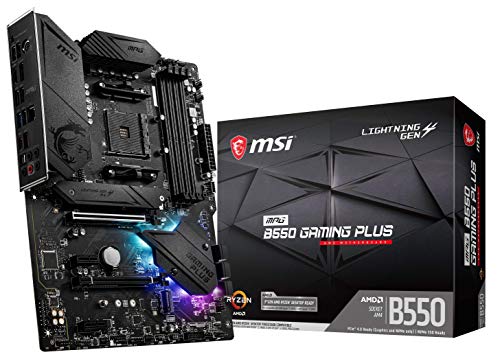
The MSI MPG B550 Gaming Plus is a well-balanced AM4 board. You get PCIe 4.0 for the GPU and one M.2 slot. There’s USB 3.2 Gen 2, DisplayPort/HDMI, and decent VRM cooling. It is an easy, dependable platform for coding rigs.
For programming, stability beats flash. This board keeps your builds steady and your drives fast. DDR4 helps you reach 64GB without breaking the bank. If you want the best motherboard for programming with a classic AM4 setup, this MSI is a strong option.
Pros:
- Stable AM4 foundation for everyday development
- PCIe 4.0 support for GPU and one NVMe
- Good VRM for stock or light OC
- Two video outputs for iGPU use
- Clean layout for easy building
Cons:
- Only one PCIe 4.0 M.2 slot
- No built-in Wi-Fi on some variants
- Older platform than AM5
My Recommendation
Choose this if you like the AM4 value stack. It suits coders who compile often and need a reliable daily driver. It handles multi-monitor setups and fast NVMe well. For many, this can still be the best motherboard for programming when you pair it with a strong Ryzen CPU and enough RAM.
| Best for | Why |
|---|---|
| Value-focused builds | AM4 prices and DDR4 savings |
| Long coding sessions | Stable power delivery |
| Single fast NVMe use | PCIe 4.0 M.2 performance |
Binary Tree Circuit Board T-Shirt

This Binary Tree Circuit Board T-Shirt is a fun coder gift. The design blends a PCB motif with binary tree vibes. It’s casual, lightweight, and great for meetups. It makes your stack stand out without saying a word.
It’s not hardware, but it pairs with your passion. Wear it to hackathons or remote standups. It’s a small morale boost during long sprints. The best motherboard for programming still needs a happy owner—style helps.
Pros:
- Geeky design that sparks conversation
- Comfortable for long days at the desk
- Good gift for teammates or mentees
- Pairs well with casual office dress codes
- Works for events, meetups, and hackathons
Cons:
- Not a hardware upgrade
- Fit and fabric may vary by size
- Design might be niche for non-coders
My Recommendation
Gift this to a dev who loves subtle tech art. It’s great for birthdays, swag bags, or team wins. It won’t make your code faster, but it adds fun to the day. Even when you already own the best motherboard for programming, a little flair goes a long way.
| Best for | Why |
|---|---|
| Developer gifts | Tech-themed design |
| Meetups and hackathons | Easy conversation starter |
| Casual workwear | Lightweight, comfortable feel |
GIGABYTE B650 AORUS Elite AX (AM5)

The GIGABYTE B650 AORUS Elite AX is a sweet-spot AM5 board. It includes WiFi 6E, 2.5GbE LAN, and solid DDR5 support. You get PCIe 5.0 for NVMe and smart build tools like EZ-Latch. Q-Flash Plus lets you update BIOS without a CPU.
For developers, it blends value and forward features. PCIe 5.0 NVMe boosts large project I/O. The 5-year warranty signals staying power. If you want the best motherboard for programming without the flagship price, this AORUS board is a top contender.
Pros:
- AM5 with DDR5 for fast compile times
- WiFi 6E and 2.5GbE for flexible networking
- PCIe 5.0 NVMe support for blazing storage
- Q-Flash Plus for safe BIOS updates
- Five-year warranty for peace of mind
Cons:
- PCIe 5.0 mainly for M.2, not GPU on B650
- Fewer USB 20Gbps ports than premium boards
- Minimal RGB for those who want flair
My Recommendation
This is ideal for pro coders and students moving to AM5. You get speed now and runway for upgrades. It is a good balance of price and power. For many buyers, this is the best motherboard for programming when you want reliability and strong I/O.
| Best for | Why |
|---|---|
| PCIe 5.0 storage | Faster NVMe for builds and VMs |
| Balanced AM5 builds | Great features at mid-range price |
| Safe BIOS updates | Q-Flash Plus convenience |
SOP8/16 BIOS Test Clip Kit

This SOP8/16 BIOS Test Clip Kit is a rescue tool. It helps you recover or flash SPI BIOS chips. The kit includes a 1.8V adapter and a socket for common 24/25 series chips. If you tinker with firmware, this belongs in your drawer.
Motherboard BIOS issues can ground your dev machine. With this kit, you can reflash chips offboard. That can save time and money. The best motherboard for programming is the one that can be recovered fast when updates go wrong.
Pros:
- Low-cost insurance against bad BIOS flashes
- Includes 1.8V adapter for wider chip support
- Useful for lab and repair scenarios
- Helps revive bricked boards
- Supports common SPI EEPROM families
Cons:
- Requires patience and care to use
- Not needed for most casual builders
- Quality varies—handle clips gently
My Recommendation
Buy this if you mod BIOS, crossflash, or test firmware. It’s also smart for a home lab with many boards. It pays for itself the first time you save a bricked system. Even the best motherboard for programming can need a lifeline; this kit provides it.
| Best for | Why |
|---|---|
| Firmware developers | Direct SPI chip programming |
| Home labs | Fast recovery after failed updates |
| Repair techs | Works with common EEPROMs |
ASUS TUF Gaming B650-PLUS WiFi (AM5)

The ASUS TUF Gaming B650-PLUS WiFi emphasizes durability. It supports Ryzen 7000 through 9000, DDR5, and PCIe 5.0 M.2. You get WiFi 6, 2.5GbE, and USB4 support. The TUF series focuses on long-term reliability and cooling.
For developers, uptime is everything. This board keeps temps controlled and power steady. It has smart headers and clean I/O for many devices. If you want the best motherboard for programming that will last for years, this TUF board is a safe bet.
Pros:
- Built for longevity and stable power
- AM5 with DDR5 and PCIe 5.0 M.2
- WiFi 6 and 2.5GbE for flexible networking
- USB4 support for high-speed peripherals
- Good heatsinks for sustained workloads
Cons:
- Not as many M.2 slots as higher-end models
- WiFi 6, not WiFi 6E/7
- Design is utilitarian, not flashy
My Recommendation
Choose this if you value stability over bling. It is ideal for long builds, remote work, and containers. It supports next-gen CPUs and fast storage. For many practical buyers, it might be the best motherboard for programming and everyday reliability.
| Best for | Why |
|---|---|
| Long coding sessions | Thermals and stable VRM |
| Forward compatibility | AM5 and USB4 support |
| Mixed networks | WiFi 6 and 2.5GbE |
ASUS TUF B760-PLUS WiFi (LGA 1700)

The ASUS TUF B760-PLUS WiFi supports Intel 12th–14th Gen chips. It brings DDR5, a PCIe 5.0 x16 slot, and three M.2 slots. You get 2.5G LAN, USB 3.2 Type-C, and Thunderbolt 4/USB4 support. TUF resilience and clean power make a stable Intel dev platform.
If you lean Intel, this is a great board. It’s ideal for VS Code, container work, and browser-heavy workflows. Plenty of USB and M.2 means fewer bottlenecks. If you want the best motherboard for programming on Intel, this is a standout pick.
Pros:
- Support for 14th/13th/12th Gen Intel Core CPUs
- DDR5 for faster dev workloads
- PCIe 5.0 GPU support
- Three M.2 slots for multi-SSD builds
- Thunderbolt 4/USB4 support for fast docks
Cons:
- No built-in WiFi 7; WiFi 6 is standard here
- B760 limits CPU overclocking
- Fewer premium extras than Z-series boards
My Recommendation
Pick this if you want a stable Intel platform with modern I/O. It helps with multi-monitor dev setups and fast external arrays. It is friendly to productivity docks. For Intel fans, this is the best motherboard for programming with great value and clean power delivery.
| Best for | Why |
|---|---|
| Intel-based dev rigs | Strong DDR5 and PCIe 5.0 |
| Dock-centric workflows | Thunderbolt 4/USB4 support |
| Multi-SSD projects | Three M.2 slots |
ASUS Prime B550-PLUS AC-HES (ATX)

The ASUS Prime B550-PLUS AC-HES is an AM4 workhorse. It offers dual M.2, PCIe 4.0, WiFi 5, and 1Gb Ethernet. You also get USB 3.2 Gen 2 Type-C and front-panel USB-C. It’s simple, clean, and cost-effective.
For devs who want reliable basics, this fits. It handles IDEs, VMs, and light containers well. The layout is friendly for first-time builders. If you need the best motherboard for programming on a classic platform, this Prime board is solid.
Pros:
- Affordable ATX with PCIe 4.0
- Dual M.2 for OS and project disks
- Front and rear USB-C support
- Clean UEFI with helpful settings
- Good stability for long uptime
Cons:
- WiFi 5 is dated next to WiFi 6/7
- 1Gb Ethernet only
- Less robust VRM than high-end models
My Recommendation
Buy this if you want a simple, stable ATX build. It suits students, indie devs, and small teams. Dual M.2 helps keep projects separate from the OS. For value seekers, it can be the best motherboard for programming when price matters most.
| Best for | Why |
|---|---|
| Budget ATX builds | Low cost with PCIe 4.0 |
| First-time builders | Friendly UEFI and layout |
| Two-SSD setups | Dual M.2 slots |
MSI PRO B550M-VC WiFi (mATX)

The MSI PRO B550M-VC WiFi targets professional reliability. It supports Ryzen 5000 CPUs, PCIe 4.0, and DDR4. You get Wi-Fi 6E, Bluetooth 5.2, HDMI/DP, and USB 3.2 Gen 2. The mATX form factor saves space without losing function.
For coding, this is a quiet partner. Wi-Fi 6E gives you cleaner 6GHz airwaves for stable calls. PCIe 4.0 keeps your NVMe fast. If you want the best motherboard for programming in a compact case, this MSI is very capable.
Pros:
- Wi-Fi 6E and Bluetooth 5.2
- PCIe 4.0 for GPU and NVMe
- Compact size with strong I/O
- Clean BIOS and reliable updates
- Good price for pro features
Cons:
- AM4 lacks the future runway of AM5
- Fewer M.2 slots than larger boards
- Limited for extreme overclocks
My Recommendation
Go with this if you want a small, steady system. It’s great for remote work and shared apartments with tight space. Wi-Fi 6E helps avoid crowded bands. For compact rigs, it may be the best motherboard for programming without bulk.
| Best for | Why |
|---|---|
| Small workstations | mATX footprint |
| Clean wireless | Wi-Fi 6E on 6GHz band |
| Everyday dev tasks | Stable power and I/O |
FAQs Of best motherboard for programming
Do I need DDR5 for programming?
Not always. DDR4 is fine for most coding. DDR5 helps with large builds, VMs, and AI tools.
Is ECC memory important for developers?
It helps with data integrity. For most desktop coding, unbuffered ECC is a nice-to-have, not a must.
AMD AM5 or Intel LGA 1700 for programming?
Both work well. Pick based on CPU needs, budget, and I/O like Thunderbolt or Wi-Fi 7.
How many USB ports should I aim for?
At least six rear USB ports is comfortable. Fast USB-C helps with external SSD scratch disks.
Is Wi-Fi 7 worth it for developers?
If you use wireless and need low latency, yes. For wired 2.5GbE users, it’s optional.
Final Verdict: Which Should You Buy?
If you want maximum runway, the ASUS ROG Strix B850-A is a top-tier, future-proof choice. It’s the best motherboard for programming when you need WiFi 7, PCIe 5.0, and four M.2 slots.
On a balanced budget, the GIGABYTE B650 AORUS Elite AX hits the sweet spot. It can still be the best motherboard for programming for most devs who want speed, stability, and value.