
Best composite to HDMI upscalers: SoundBeast 2.0, EASYCEL, and StarTech VID2HDCON2.
You found a box of old VHS tapes, or your N64 still makes you smile. But your modern TV has only HDMI ports, and the picture looks soft, squished, or won’t show at all. A solid composite-to-HDMI upscaler solves that. It cleans up the analog signal, locks the aspect ratio, and outputs a stable 720p or 1080p feed your TV understands. Below, I break down the best composite to HDMI upscaler options for different needs, budgets, and setups, so your retro media can look its best on today’s screens.
SoundBeast AV to HDMI Converter & Recorder 2.0

The SoundBeast 2.0 is a rare combo: an AV-to-HDMI upscaler and a basic recorder. It takes your composite source and outputs 1080p over HDMI. It also supports a 4:3 aspect ratio mode, which matters a lot for older tapes and consoles. With USB video capture, you can record your footage to a computer for archiving or sharing.
Setup is simple. Plug in your RCA cables, connect HDMI to your TV, and enable the recording function when you need it. VHS, Hi8, and camcorder content benefit from the scaling and aspect control. It is an easy pick if you want to both watch and digitize your memories without juggling multiple boxes.
Pros:
- Upscales composite to a clean 1080p HDMI signal
- Built-in USB video capture for easy recording
- 4:3 aspect ratio mode preserves original framing
- Simple connections and quick setup
- Good choice for VCRs, Hi8, and camcorders
Cons:
- Recorder is basic; not a pro capture card
- Focuses on 4:3 content; advanced widescreen tools are limited
- No deinterlacing controls for fine tuning
My Recommendation
If you want the best composite to HDMI upscaler that can also record, this is the practical pick. It balances a sharp 1080p output with a 4:3 mode that keeps old footage correct. It is great for families digitizing VHS and for anyone who wants a neat, all-in-one box. The overall value is strong and it is often in stock.
| Best for | Why |
|---|---|
| VHS and Hi8 archiving | Built-in USB capture and 4:3 mode keep tapes authentic |
| Retro console playback | 1080p HDMI output with stable scaling |
| Simple home setups | Easy wiring and minimal menu fuss |
Tendak HDMI to AV/S-Video Converter (720p/1080p)

This one is different. It takes an HDMI source and converts it to composite or S-Video. That means it sends a modern device to an older TV or VCR for recording or viewing. It is not for converting composite to HDMI, but I included it because many people end up buying the wrong direction by mistake.
If you have a Blu-ray player, laptop, or streaming stick and want to display it on a classic CRT, this will do the job. It supports both composite and S-Video, which is a little cleaner than composite. Use it for demonstrations, older capture workflows, or nostalgia with a tube TV. Just make sure your goal is HDMI to AV, not the other way around.
Pros:
- Handles HDMI to composite and S-Video conversion
- Useful for older TVs, VCRs, or archival workflows
- Supports common HDMI resolutions up to 1080p
- Includes the AV/S-Video connections you need
- Good build for a small converter
Cons:
- Not a composite to HDMI upscaler
- Analog output will look softer on large screens
- Uni-directional; cannot do AV to HDMI
My Recommendation
If your goal is to feed HDMI into a CRT, this is a solid choice. But if you want the best composite to HDMI upscaler for modern TVs, pick one of the other units on this list. Get this only when your path is HDMI to AV. It remains a handy problem-solver for retro displays and capture decks.
| Best for | Why |
|---|---|
| Playing modern devices on CRTs | Converts HDMI to composite or S-Video |
| Legacy VCR/DVD recording | Lets you record HDMI sources to analog gear |
| Retro exhibitions | Simple way to show new content on old screens |
EASYCEL RCA/S-Video to HDMI Converter

The EASYCEL converter is a clean, compact upscaler that accepts composite or S-Video and outputs HDMI. You can switch between 720p and 1080p, which helps with TVs that prefer one format. S-Video support is a real perk for N64 and PS2 users who want a cleaner signal than yellow RCA. It works well for DVDs too, especially budget players that only offer composite or S-Video.
I like its simple toggle for resolution. It also tends to lock sync quickly, which means fewer dropouts. This unit is a steady daily driver if you are moving between consoles and VCRs. It hits the sweet spot of price, performance, and ease of use.
Pros:
- Upscales composite or S-Video to HDMI
- 720p/1080p output switch for TV compatibility
- Good for N64, PS2, and Wii with S-Video
- Compact and simple to wire
- Stable sync and minimal fuss
Cons:
- No capture or recording features
- Limited aspect controls; rely on your TV if needed
- Basic deinterlacing for fast motion
My Recommendation
If you want a dependable, affordable unit, EASYCEL is one of the best composite to HDMI upscaler options. It shines for N64 and PS2 with S-Video. It is also a great pick for anyone who wants a clean plug-and-play setup. Stock levels stay good, and the value is easy to justify.
| Best for | Why |
|---|---|
| N64 and PS2 owners | S-Video input yields a crisper picture |
| Mixed retro setups | 720p/1080p switch helps across TVs |
| Budget-friendly upgrades | Solid quality without extra costs |
StarTech Composite/S-Video to HDMI (VID2HDCON2)

StarTech is known for reliable, business-grade converters. The VID2HDCON2 converts composite or S-Video to HDMI and scales to 720p. It supports both NTSC and PAL, so international tapes and consoles are fine. While it tops out at 720p, that can be ideal for some displays that handle 720p better than 1080p upscales.
Build quality is solid. The unit does a good job with color stability and sync. For conference rooms, classrooms, and long-term installs, the brand support and driver-free operation matter. It is not flashy, but it is steady and dependable.
Pros:
- Trusted brand with consistent performance
- Composite and S-Video support
- 720p output works well on many TVs
- PAL and NTSC compatible
- Good for business or education settings
Cons:
- Does not output 1080p
- No capture/recording features
- Higher price than basic boxes
My Recommendation
Pick this if you want a set-and-forget unit from a trusted name. It is one of the best composite to HDMI upscaler options for classrooms and offices. The 720p output is stable and clean, and S-Video looks especially nice. It is usually available year-round, which helps for replacement planning.
| Best for | Why |
|---|---|
| Business installs | Reliable brand, consistent 720p output |
| Classrooms | PAL/NTSC support for varied sources |
| S-Video sources | Good clarity and color handling |
DigitConvert Mini AV to HDMI Converter 1080p

The DigitConvert mini box is tiny, cheap, and quick to use. It converts composite to HDMI at up to 1080p. It is ideal for an easy hookup of a VCR or older console to a modern TV. If you want a no-frills bridge that just works, this is that type of device.
Picture quality is in line with other budget upscalers. Your source matters more than the box at this level. It supports PAL and NTSC, which helps when you have tapes from different regions. Keep expectations fair, and it will serve you well for casual viewing.
Pros:
- Affordable and compact
- 1080p HDMI output
- Simple plug-and-play setup
- PAL/NTSC support
- Great as a spare or travel unit
Cons:
- No S-Video input for cleaner sources
- Basic deinterlacing; motion can blur
- No aspect ratio switch
My Recommendation
On a tight budget, this is one of the best composite to HDMI upscaler choices. It brings your VCR or retro console to life on an HDMI TV without fuss. Save it for casual movie nights or lightweight gaming. It offers strong availability and an easy value proposition.
| Best for | Why |
|---|---|
| Budget shoppers | Low cost with 1080p output |
| Quick fixes | Plug-and-play, no menus |
| Mixed analog sources | PAL/NTSC compatibility |
BD&M AV to HDMI Adapter (PAL/NTSC)

The BD&M adapter is another simple converter that turns composite into HDMI. It supports both PAL and NTSC. It is a tiny box that is easy to tuck behind a TV or mount in a cabinet. The output is stable and works for DVDs, VCRs, and older game consoles.
I view this as a utility tool. It is not a premium scaler, but it does the core job well. For basic viewing and light gaming, it is fine. Use it when you need a reliable, low-hassle link from RCA to HDMI.
Pros:
- Compact size fits behind TVs
- Simple RCA to HDMI conversion
- PAL/NTSC compatible
- Budget-friendly
- Works for tapes, discs, and consoles
Cons:
- No S-Video input
- Basic scaling and motion handling
- Limited controls for aspect or sharpening
My Recommendation
If you want the best composite to HDMI upscaler for the lowest price, this checks the box. It is perfect for on-the-go setups or a guest room TV. It will not add details that are not in the source, but it will provide a watchable HDMI feed. It is widely available and easy to recommend for simple needs.
| Best for | Why |
|---|---|
| Casual VHS viewing | Affordable and stable output |
| Spare-room TVs | Small footprint and easy install |
| Basic consoles | Handles composite without fuss |
4-Port RCA to HDMI Converter with Remote

Got more than one retro device? This 4-port converter is a smart hub. It accepts four composite inputs and outputs a single HDMI feed at 720p or 1080p. A remote lets you switch inputs from the couch. The unit also offers a 4:3/16:9 switch, which is key for older content.
If you rotate between Sega, N64, PS2, and a VCR, this saves time. You do not need to swap cables or buy a separate switcher. The scaling is on par with other mid-tier boxes. The aspect toggle helps keep classic titles from looking stretched or squashed.
Pros:
- Four inputs with a handy remote
- Upscales to 720p or 1080p
- 4:3/16:9 aspect switch
- Great for multi-console setups
- Reduces cable clutter
Cons:
- Composite only; no S-Video inputs
- Remote can feel basic
- Larger footprint than single-input boxes
My Recommendation
For collectors and tinkerers, this is one of the best composite to HDMI upscaler options. The remote and aspect switch make daily use easy. Keep all your consoles and a VCR plugged in and ready. It is a strong value for multi-device households and is often stocked well.
| Best for | Why |
|---|---|
| Retro game stations | Four inputs and remote switching |
| Living room setups | Aspect control prevents stretching |
| Mixed devices | 720p/1080p output for different TVs |
Tendak Composite & S-Video to HDMI Converter

This Tendak converter handles both composite and S-Video to HDMI, which is ideal for sources like SNES, N64, and PS2. It supports 720p or 1080p output. It also comes with the needed cables, which is a nice extra. The image holds steady, and S-Video mode gives a subtle but welcome clarity boost.
For older Nintendo consoles, S-Video can reduce dot crawl and color bleed. That can make sprites and UI text look cleaner. This unit is great for retro gaming and DVD playback. Plug it in, set the resolution, and enjoy the upgrade to HDMI.
Pros:
- S-Video and composite inputs
- 720p/1080p output for flexibility
- Good stability and color handling
- Includes useful cables
- Ideal for classic Nintendo and PS2
Cons:
- No capture features
- Basic deinterlacing can soften motion
- No on-device aspect ratio switch
My Recommendation
If you love retro consoles, this is one of the best composite to HDMI upscaler picks. S-Video support is the star feature. It offers a clean upgrade without overthinking it. Availability is solid, and the included cables add value.
| Best for | Why |
|---|---|
| SNES/N64/PS2 players | S-Video improves clarity over composite |
| DVD playback | Stable scaling to HDMI |
| Plug-and-play users | Simple setup with provided cables |
Tengchi RCA to HDMI Converter 1080p
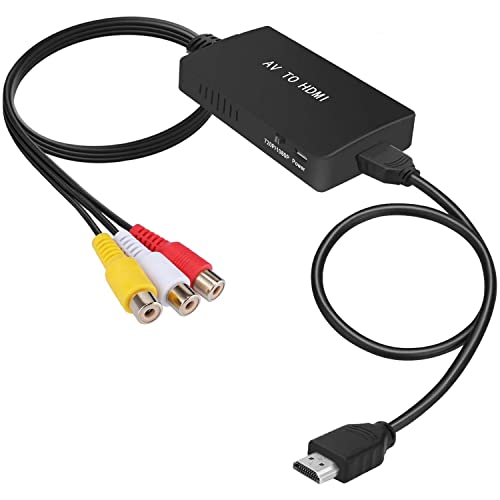
The Tengchi converter is a straightforward RCA-to-HDMI upscaler with 1080p output. It is lightweight, small, and easy to stash. It works with PAL and NTSC, which is useful for imported tapes or consoles. It is a practical pick for anyone who wants a quick upgrade path.
Image quality is what you expect from a compact upscaler. Keep cable runs short and clean for best results. It will not create detail that is not there, but it will deliver a stable HDMI feed. That is exactly what many living room setups need.
Pros:
- 1080p HDMI output
- Supports PAL and NTSC
- Small and easy to place
- Fast setup for VCRs and consoles
- Good as a backup adapter
Cons:
- Composite only; no S-Video
- Basic scaling; limited image controls
- Occasional handshake quirks on some TVs
My Recommendation
As a simple bridge, Tengchi is one of the best composite to HDMI upscaler picks for the money. It is perfect for tape nights or casual retro gaming. It is also a handy spare for travel or second TVs. It tends to be easy to find when you need one fast.
| Best for | Why |
|---|---|
| Casual VHS nights | Simple, stable 1080p HDMI |
| Imported media | PAL/NTSC support |
| Backup use | Compact and low-cost |
RuiPuo 2-Port AV to HDMI Converter

The RuiPuo box gives you two AV inputs and a single HDMI output. You can switch between 4:3 and 16:9, which is ideal for VHS and older DVD players. That aspect control prevents stretched or squashed images. It is a nice middle ground between a single-input box and a 4-port hub.
The scaling is smooth, and toggling inputs is fast. If you only need two devices connected, this keeps clutter down. I like it for a living room VCR plus a retro console. It delivers a clean HDMI feed with the right shape on screen.
Pros:
- Two AV inputs for quick switching
- 16:9 and 4:3 aspect switch
- Stable scaling for tapes and consoles
- Good balance of size and features
- Easy to use daily
Cons:
- No S-Video support
- Limited image tweaks beyond aspect
- Remote not included on some packages
My Recommendation
If you bounce between two devices, this is one of the best composite to HDMI upscaler choices. The aspect control is a real win for VHS. It is small, tidy, and great for a family room. It is also commonly available, which helps for replacements.
| Best for | Why |
|---|---|
| VCR + console setups | Two inputs reduce cable swaps |
| Older TV shows | 4:3 mode preserves original framing |
| Family rooms | Compact, simple, reliable |
How to Choose the Best Composite to HDMI Upscaler
Finding the best composite to HDMI upscaler comes down to a few key points. First, decide if you need composite only, or composite plus S-Video. S-Video improves clarity for consoles like N64 and PS2. If you have that option on your gear, take it.
Next, think about resolution. Many TVs handle 1080p well. Some older or budget displays prefer 720p. If your TV drops signal or shows odd scaling, try 720p. A switchable 720p/1080p output gives you a backup plan.
Aspect ratio control matters. Most old content is 4:3. A box with a 4:3 toggle prevents stretching. If the converter does not have it, your TV might. But having the switch on the converter is easier.
For large collections, consider multi-input options. A 2-port or 4-port unit cuts cable swaps and keeps your setup clean. If you plan to archive tapes, look for capture features like on the SoundBeast 2.0. Note that capture is basic on these boxes; serious archiving calls for dedicated capture cards.
What to Expect From Upscaling Composite
Composite video is an old, low-bandwidth format. It carries color and brightness together, which can cause color bleed and dot crawl. An upscaler will not add new detail. It will clean and scale the image to fit your HDMI screen.
Using S-Video, when available, helps. S-Video splits brightness and color into separate signals. That reduces artifacts and sharpens edges. If your console or camcorder supports S-Video, use it.
Deinterlacing is also key. Many tapes and classic consoles output interlaced video. Budget upscalers use simple deinterlacing, which can blur fast motion. For movies and TV shows, it is usually fine. For purist gaming, higher-end scalers exist, but they cost more and can add complexity.
Setup Tips for a Better Picture
Keep your RCA cable runs short and good quality. Long, thin cables can pick up noise. Use the red and white audio cables too, so you get stereo where available. If your source supports S-Video, use it instead of yellow RCA.
Try both 720p and 1080p outputs. Some TVs scale one better than the other. If your image is jittery or drops out, test the other mode. Also check your TV’s aspect settings. Use 4:3 for most tapes and classic games to avoid stretching.
Clean your VCR heads and console contacts. A dirty source feeds noise into any converter. Small steps here can make a big difference. If you digitize, set a stable playback speed and avoid fast forward or rewind during capture.
FAQs Of best composite to hdmi upscaler
Do these upscalers improve picture quality?
They clean and scale the image, but they cannot create new detail. Expect a stable HDMI feed, better compatibility, and correct aspect ratio. Use S-Video if possible for a small clarity boost.
Should I choose 720p or 1080p output?
Try both. Many TVs handle 1080p well. Some budget or older TVs prefer 720p. If you see dropouts or odd scaling, switch to 720p.
Is S-Video really better than composite?
Yes, when available. S-Video separates brightness and color, which reduces artifacts. It often looks cleaner on consoles like N64 and PS2.
Will a composite to HDMI box add lag?
Most add a tiny delay. For movies, you will not notice. For gaming, budget boxes are usually fine for casual play. Competitive players may want specialty scalers.
Can I record my tapes with these?
The SoundBeast 2.0 includes basic USB video capture. For pro archiving, use a dedicated capture card and a well-maintained VCR. Keep expectations realistic with old tapes.
Final Verdict: Which Should You Buy?
For the best composite to HDMI upscaler overall, I like SoundBeast 2.0 for its 1080p output, 4:3 mode, and USB capture. If you want simple, EASYCEL and Tendak (S-Video model) are great daily drivers.
For multi-device setups, the 4-Port RCA to HDMI with remote is a win. Need a rock-solid 720p scaler? Go StarTech. Think about your inputs, aspect needs, and capture plans, then pick with confidence.