Best pick: ASUS RTX 5060 pairs beautifully with the i5‑9600K at 1080p/1440p.
You built a solid rig with an i5‑9600K and now want a graphics card that makes it feel new again. You want smooth 1080p performance, maybe a jump to 1440p, without wasting money on frames your CPU cannot feed. You also want modern features like AV1 encoding for streaming, VRR for a tear-free screen, and smart power use. This guide breaks down the best graphics card for i5 9600k across budgets and cases. I test how each option fits older PCIe 3.0 boards, what power supply you need, and where you’ll see the biggest wins.
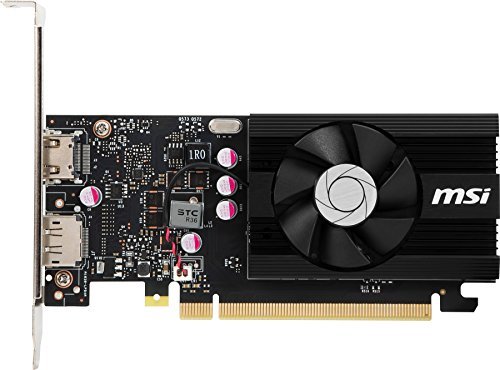
MSI GeForce GT 1030 4GB DDR4 Low Profile
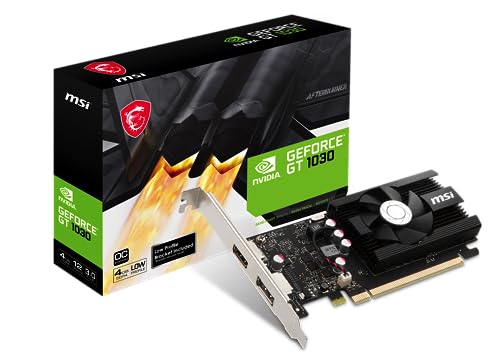
If you are building a silent, compact PC, the MSI GT 1030 DDR4 keeps things easy and cool. It fits in small cases and sips power, so you can use a basic power supply. It handles 4K video playback, multi-monitor desktop use, and light eSports at reduced settings. For people who just need reliable display outputs, it does the job.
That said, this DDR4 variant is slower than the older GDDR5 GT 1030. Gaming performance is limited, even at 720p in modern titles. It still supports DirectX 12 and works fine with the i5‑9600K on a PCIe 3.0 board. If you want simple, quiet, and cheap, it is a low-risk pick.
Pros:
- Low profile design fits small form factor cases
- No extra power connector needed
- Very low heat and noise under load
- Great for 4K video playback and office work
- Easy plug-and-play on older PCIe 3.0 motherboards
Cons:
- DDR4 memory makes it much slower than GDDR5 GT 1030
- Not ideal for modern 1080p gaming
- Limited driver optimization for new AAA games
My Recommendation
This card is best for users who need stable display output, media playback, and quiet operation. If you game rarely, or only play classics and light eSports, it works with low fuss. It is not the best graphics card for i5 9600k if gaming is your goal, but it shines for simple needs, HTPCs, or a stop-gap while you plan a bigger upgrade.
| Best for | Why |
|---|---|
| HTPC and media PCs | Low power, quiet, smooth 4K video |
| Small form factor builds | Low profile and cool running |
| Basic multi-monitor setups | Reliable DP/HDMI outputs |
PNY GeForce RTX 5050 Dual Fan (8GB)
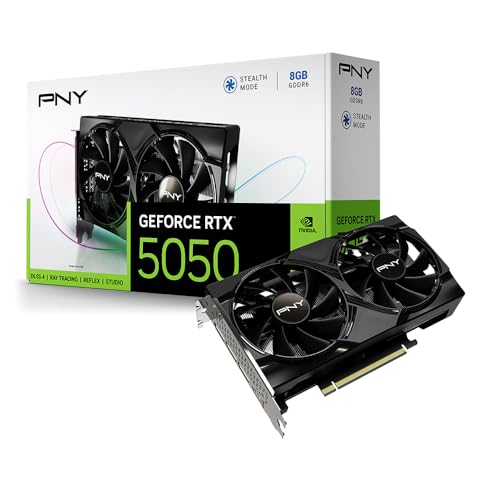
The RTX 5050 is a sweet spot for pairing with the i5‑9600K. It brings the latest NVIDIA Blackwell architecture, DLSS 4 upscaling, and advanced AV1 encoding. You get fast 1080p performance and workable 1440p in many games with smart settings. The dual-fan cooler stays quiet and fits two-slot cases.
It uses PCIe 5.0, but it is fully backward compatible with PCIe 3.0 on LGA1151 boards. That means your i5‑9600K rig can drop this in and go. VRR and HDMI 2.1 make high refresh gameplay smooth and clean. If your PSU is decent and you want a modern feature set, this is a strong match.
Pros:
- DLSS 4 boosts frames at 1080p and 1440p
- AV1 encode for streaming and capture
- Quiet dual-fan design in a compact shroud
- PCIe 5.0 device works fine in PCIe 3.0 slots
- Good price-to-performance for older CPUs
Cons:
- 8GB VRAM can limit ultra textures in a few titles
- CPU bottleneck at very high FPS in 1080p shooters
- Pricing may overlap with used higher-tier GPUs
My Recommendation
If you want the best graphics card for i5 9600k without overspending, this hits the mark. It breathes life into older rigs by adding DLSS 4, better encoders, and efficient power use. It is ideal for 1080p high refresh and balanced 1440p. It is also a great pick for streamers who want safer CPU headroom.
| Best for | Why |
|---|---|
| 1080p high-refresh gaming | DLSS 4 + strong raster at sensible power |
| Streaming and content capture | AV1 encoder and NVENC quality |
| Drop-in upgrades | Backwards compatible with PCIe 3.0 boards |
Intel Core i5-12600K with Integrated Graphics

This is not a graphics card, but it matters if you are planning ahead. The i5‑12600K is a huge CPU upgrade over the i5‑9600K, with 6 performance cores and 4 efficiency cores. It also brings a capable iGPU for display and media, which helps while you save for a discrete GPU. For many games, the extra CPU muscle removes bottlenecks.
Note that this move needs a new motherboard and likely new RAM. The power draw is higher, but cooling is easy with a decent air cooler. If your end goal is to drive a stronger GPU later, this will set a better foundation. It is a smart path if your i5‑9600K is holding back a fast card.
Pros:
- Big CPU performance jump versus i5‑9600K
- Integrated graphics for basic display and media
- Better 1% lows in CPU-heavy games
- Great platform for modern GPUs
- Efficient when tuned; supports new features
Cons:
- Requires new motherboard and RAM
- Not a discrete GPU; limited gaming on iGPU
- Higher TDP means better cooling needed
My Recommendation
If you are set on a platform upgrade soon, consider this as a bridge. It is not the best graphics card for i5 9600k because it is a CPU, but it solves CPU bottlenecks. Use the iGPU for now, then add a modern GPU later for a big leap. It makes sense if you care about long-term value and smooth 1% lows.
| Best for | Why |
|---|---|
| Future-proofing your rig | New architecture and features |
| Removing CPU bottlenecks | More cores and better scheduling |
| Temporary GPU-free builds | Integrated graphics for displays |
GPVHOSO GeForce GTX 750 Ti 4GB Dual Fan

The GTX 750 Ti still has a place in ultra-budget builds. It often needs no 6‑pin connector and runs cool and quiet. You can play older AAA games and light eSports at 720p to 900p. For a quick fix card to get a PC running, it holds up better than you’d expect.
Driver support is stable, but modern features are missing. VRAM is tight, and new codecs like AV1 are not here. On the i5‑9600K, it will not push high frames, but it will be reliable. If you just want to play classic titles and don’t want to swap the PSU, it can work.
Pros:
- Runs without extra power in many systems
- Cool and quiet dual-fan cooling
- Fine for older eSports and classic games
- Simple plug-and-play on PCIe 3.0
- Great as a placeholder GPU
Cons:
- Very limited performance in modern games
- No AV1, no modern AI upscalers
- 4GB at 128-bit is restrictive
My Recommendation
Pick this if your budget is very tight or you are restoring an older PC. It is not the best graphics card for i5 9600k for gaming, but it gets you playing. It fits low-power systems and is safe for older PSUs. Plan to upgrade later for 1080p high settings.
| Best for | Why |
|---|---|
| Ultra-budget builds | Cheap, stable, low power draw |
| Classic and indie titles | Enough muscle at 720p–900p |
| Stop-gap GPU | Works while you save for better |
MOUGOL Radeon RX 580 8GB Dual Fan
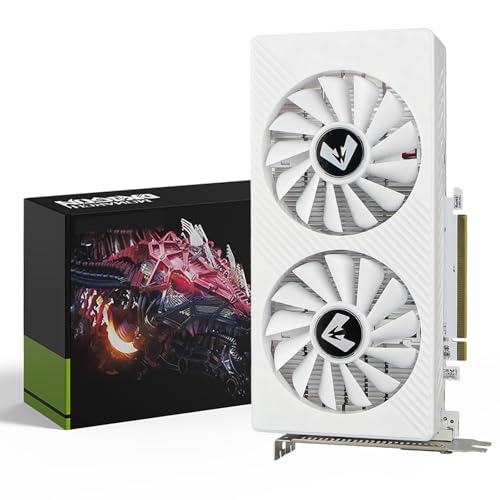
The RX 580 is a proven workhorse for 1080p gaming. With 8GB VRAM and a 256‑bit bus, it handles texture-heavy titles better than older midrange cards. On the i5‑9600K, it can drive high settings in many eSports and mid- settings in newer AAA games. The dual-fan cooler helps keep temperatures in check.
Power draw is higher than newer cards, so check your PSU. It lacks modern AI upscalers like DLSS 4, but FSR still helps. Drivers remain solid for 2026-level support. If you want budget 1080p play and don’t mind extra watts, it is dependable.
Pros:
- 8GB VRAM with 256‑bit bandwidth
- Strong 1080p performance for the price
- Good thermals with dual fans
- FSR support to boost frames
- Mature driver support
Cons:
- High power consumption compared to newer GPUs
- No AV1 encode and limited modern features
- Varied quality control in some aftermarket models
My Recommendation
If you want the best graphics card for i5 9600k at low cost, this is a classic choice. It meets 1080p needs with headroom for textures and modded games. It is a smart pick when power is less of a concern than price. Just pair it with a quality 500–550W PSU.
| Best for | Why |
|---|---|
| Budget 1080p gaming | 8GB VRAM and wide memory bus |
| Texture-heavy games | Handles high-res packs better |
| Mid settings in new titles | Solid raster performance |
QTHREE GeForce GT 730 4GB Low Profile

The GT 730 is a utility card for compact systems and legacy displays. It offers dual HDMI, DP, and VGA, which can be handy for mixed monitor setups. It runs cool, uses little power, and slides into PCIe 2.0/3.0 slots with no fuss. For office work, home theater use, and basic games, it is fine.
Gaming potential is very limited. DDR3 memory and a 64‑bit bus hold it back in new titles. If you are on an i5‑9600K, this card does not tap its strength for gaming. But for value builds that need extra outputs, it is a reliable option.
Pros:
- Very low power and heat output
- Works in older and newer PCIe slots
- Triple display flexibility (2x HDMI, DP, VGA)
- Good for office and HTPC use
- Low profile for SFF cases
Cons:
- Not suitable for modern 1080p gaming
- DDR3 memory limits bandwidth
- Driver optimizations are basic for new titles
My Recommendation
This is a functional card when you need outputs, not frames. It is not the best graphics card for i5 9600k if you care about gaming. It shines in small form factor PCs that need multiple screens or a simple video pipeline. If you want value and compatibility, it checks the boxes.
| Best for | Why |
|---|---|
| Office and HTPC use | Low noise, low power, stable output |
| Legacy displays | VGA plus modern HDMI/DP |
| SFF builds | Low profile and cool operation |
ASUS Prime GeForce RTX 5060 8GB OC

This is my favorite pairing for the i5‑9600K in 2026. The RTX 5060 with GDDR7 brings high efficiency, DLSS 4, and strong AV1 encode/ decode. It handles 1080p ultra with ease and moves well into 1440p, especially with DLSS Quality. ASUS’s cooler is quiet, and the dual BIOS adds a silent mode.
PCIe 5.0 support is painless on PCIe 3.0 boards, and the GPU does not saturate the older link in real use. You may see CPU limits in very high FPS eSports at 1080p, but that is expected on 9600K. For most users, this is the best graphics card for i5 9600k because it balances features, frames, and power.
Pros:
- GDDR7 memory for better efficiency
- DLSS 4 for smart 1440p performance
- Excellent AV1 streaming and recording
- Quiet cooler with dual BIOS
- Great balance for PCIe 3.0 systems
Cons:
- CPU bottleneck in 1080p at very high refresh
- 8GB VRAM can pinch in ultra RT titles
- Price premium over older-gen cards
My Recommendation
This is the best graphics card for i5 9600k if you want a modern, balanced upgrade. It lifts your build into 2026 with DLSS 4 and AV1 while staying cool and quiet. It is a safe buy for 1080p and a smart entry into 1440p. You will feel the upgrade in both games and content creation.
| Best for | Why |
|---|---|
| 1080p ultra + 1440p high | DLSS 4 and efficient GDDR7 |
| Streaming and capture | Top-tier AV1 encoders |
| Quiet gaming | Axial-tech fans, dual BIOS |
AISURIX RX 580 8GB (2048SP) by Kelinx

This card is labeled RX 580 2048SP, which is closer to an RX 570 in speed. It still carries 8GB VRAM and a 256‑bit bus, which helps in texture-heavy games. On an i5‑9600K, you can expect 1080p medium to high in many titles. The cooler design with freeze fan stop keeps idle noise at zero.
Power draw can be high, so plan for a decent PSU. Driver support is mature, though you miss newer features like AV1 encode. If the price is right, it can be good value for budget gaming. Read the listing details carefully, as 2048SP variants differ from full RX 580 (2304 SP).
Pros:
- 8GB VRAM and wide bus help with textures
- Good 1080p value at the right price
- Fan stop for silent idle
- Stable drivers for older titles
- Simple PCIe 3.0 compatibility
Cons:
- Slower than a true RX 580 (2304 SP)
- Higher power use
- No modern encode features like AV1
My Recommendation
If your budget is tight and you want 1080p gaming now, this works. It is not the very best graphics card for i5 9600k, but it is honest value. Make sure you know it is a 2048SP spec. For the price, it can be a solid stepping stone card.
| Best for | Why |
|---|---|
| Budget 1080p | 8GB VRAM with wide bus |
| Texture-heavy mods | More memory headroom |
| Quiet idle PCs | Freeze fan stop feature |
GIGABYTE GeForce GT 710 2GB DDR3
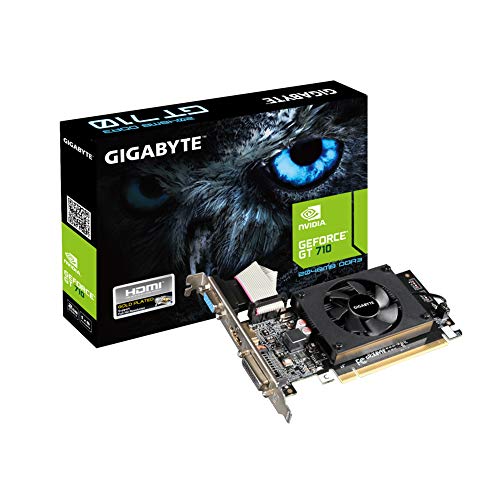
The GT 710 is a basic display card. It is perfect if you need to bring an older PC to life with stable outputs. It runs cool, draws little power, and fits almost anywhere. For a secondary or office machine, it is a safe choice.
It is not for gaming. DDR3 memory and a very small core make it slow for anything beyond light classics. Still, it can be a handy tool for troubleshooting, BIOS access, and multi-monitor setups. Paired with an i5‑9600K, it is only a temporary solution if you plan to game later.
Pros:
- Ultra-low power and heat
- Simple multi-monitor output
- Good compatibility across systems
- Silent or near-silent operation
- Budget-friendly utility card
Cons:
- Not suitable for modern games
- Very limited compute performance
- No modern video encoding features
My Recommendation
If you need a display adapter fast, this works. It is not the best graphics card for i5 9600k for gaming, but it is fine for display duty. Use it to get your system running or to power simple tasks. Upgrade to a modern GPU when you can.
| Best for | Why |
|---|---|
| Office or secondary PCs | Stable, low power, silent |
| Basic multi-monitor | Reliable outputs |
| Diagnostics | Easy drop-in for quick tests |
HyperRender RX 580 8GB (2048SP)

Like other 2048SP variants, this model performs close to RX 570 levels. You still get 8GB VRAM and a 256‑bit bus, which help at 1080p. The cooler includes a fan-stop mode to keep your system quiet at idle. For the right price, it is a useful budget card.
You will miss modern features and see higher power draw than new-gen parts. Be mindful of listing details to ensure you get what you expect. With an i5‑9600K, it delivers smooth play in older titles and many newer games at medium settings. It is better than iGPU solutions by a long shot.
Pros:
- 8GB VRAM and strong memory bandwidth
- Fan-stop for silent idle operation
- Decent 1080p performance on a budget
- Good fit for PCIe 3.0 systems
- Mature drivers and game profiles
Cons:
- Slower than full RX 580 models
- Higher wattage vs newer architectures
- No AV1 and limited new features
My Recommendation
Buy this if you need 8GB VRAM at a low cost and play at 1080p. It is not the best graphics card for i5 9600k overall, but it is practical. Keep settings balanced and enjoy solid performance for the money. Upgrade later when power efficiency and features matter more.
| Best for | Why |
|---|---|
| Budget 1080p | 8GB VRAM helps with textures |
| Quiet desktop use | Fan-stop cuts idle noise |
| Value seekers | Low cost per frame |
FAQs Of best graphics card for i5 9600k
Will the i5‑9600K bottleneck modern GPUs like an RTX 5060?
At very high FPS in 1080p eSports, yes, a bit. At 1440p or with DLSS, the GPU matters more and bottlenecks drop.
Is PCIe 5.0 backward compatible with my Z390 board?
Yes. PCIe is backward compatible. An RTX 5050/5060 will run fine in a PCIe 3.0 x16 slot with minimal loss.
How much power do I need for the best graphics card for i5 9600k?
For midrange GPUs like RTX 5050/5060, a quality 550–650W PSU is safe. Check the card maker’s spec to be sure.
Is 8GB VRAM enough in 2026?
For 1080p and many 1440p games with balanced settings, yes. Ultra textures and heavy ray tracing may need more.
Should I upgrade the CPU instead of the GPU?
If you own a fast GPU and see low 1% lows, a CPU upgrade helps. Otherwise, a GPU upgrade gives the biggest gains.
Final Verdict: Which Should You Buy?
If you want the safest, most modern match, the ASUS RTX 5060 is the best graphics card for i5 9600k. It balances features, frames, and noise, and works great on PCIe 3.0.
If you want value, consider the PNY RTX 5050 or an RX 580 8GB for budget 1080p. Either way, you’ll feel a big jump without replacing your CPU today.